

For all you Etsy sellers and DIY wizards:
Nervous about selling products without preservatives, but we also want to stay true to your natural mission. If you’re making and selling your own cleaning supplies or personal-care products, you know the tension: keep it “clean” (minimal, natural ingredients) yet safe (microbial stability is real). Here’s a list of natural and nature derived preservatives, including essential Natural Preservatives, you can use and still live up to your ingredient transparency, earth-friendly branding, and Butterfly & Bee values. By incorporating additional Natural Preservatives, you enhance the safety and longevity of your products, ensuring they remain effective for your customers.
🔍 Why preservatives matter
If your formula contains water, botanical extracts, surfactants, or anything that can support microbial growth (think: cleaning sprays, scrubs, lotions, mists), then yes you need a preservative. One blogger puts it simply:
“That’s because germs and bacteria thrive in water… A cream made with water definitely needs a preservative.” Bottega Zero Waste+1
Using no preservative is a risk (mold, bacteria) and a legal/regulatory exposure if you sell.
So the question is: how can you preserve naturally, meaning minimal synthetic heavy-hitters, aligned with your brand’s ethos?
Top 5 natural or nature-derived preservatives (with notes for DIY makers)
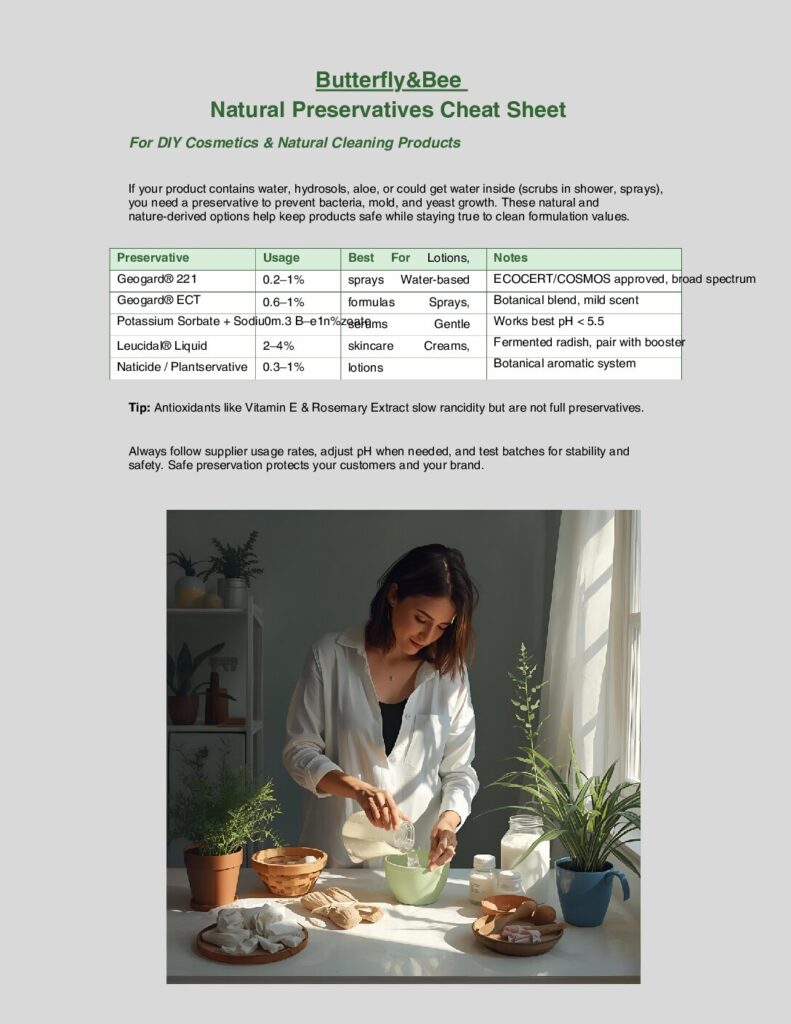
1. Benzyl Alcohol + Dehydroacetic Acid blends (trade names like Geogard® 221, Ecogard® ECT)
Natural Preservatives play a vital role in the safety and effectiveness of your products.
Utilizing Natural Preservatives not only aligns with your brand’s ethos but also appeals to eco-conscious consumers who prioritize sustainability.
When considering your formulations, it’s crucial to understand the role of Natural Preservatives in extending shelf life and preventing spoilage.
Utilizing Natural Preservatives can enhance your product’s integrity and appeal to consumers looking for safe options.
Many DIY enthusiasts are turning to Natural Preservatives to maintain the integrity of their formulations. Understanding the different options available for Natural Preservatives can help you make informed choices.
- Contains: benzyl alcohol (and) dehydroacetic acid (for example) or other blends combining benzyl alcohol + salicylic acid + glycerin + sorbic acid. Formula Botanica+1
- Why we like it: Broad spectrum, COSMOS/Ecocert certified versions exist, suitable for natural/organic brands. School of Natural Skincare
- DIY tip: Typically used at 0.2-1% (check manufacturer guidance). Good for water-incorporating formulas (cleansers, sprays).
- Branding angle: “Nature-derived antimicrobial blend” sounds strong.
2. Potassium Sorbate + Sodium Benzoate (organic acids + salts)
Many brands are now opting for Natural Preservatives to align with eco-conscious consumer preferences.
- Example: Euxyl® K 712 is a mix of sodium benzoate + potassium sorbate. School of Natural Skincare+1
- Why: These are familiar, food-grade preservatives, give good mold/yeast control in the right pH.
- DIY tip: They work best when pH is acidic (ideally pH below ~5.5). If your formula is alkaline (like many cleaning agents) you’ll need to evaluate compatibility. School of Natural Skincare
- Branding angle: “Food-grade acid salts for mold/yeast control”.
3. Rosemary Extract, Tea Tree Oil, Vitamin E (Tocopherol) — natural antioxidants + mild antimicrobials
- From a cosmetic-industry overview: rosemary extract is primarily an antioxidant, tea tree oil has antibacterial/antifungal effects, vitamin E helps prevent oil rancidity. SkinConsult+1
- Why: Great for adding to oils, but note: they alone are not enough for full broad-spectrum preservation (bacteria, mold, yeast) especially in water-based formulas. Oh, The Things We’ll Make!
- DIY tip: Use them in combination with a more robust preservation system; call them “supporting antioxidants/antimicrobials” rather than full preservative.
- Branding angle: “Botanical extract duo supports shelf-life naturally”.
For DIY makers, understanding the role of Natural Preservatives is crucial, especially in formulations that are water-based.
4. Ethyl Lauroyl Arginate (LAE) — amino acid-based antimicrobial
Integrating Natural Preservatives into your formulations not only enhances safety but also ensures compliance with natural product standards.
- This compound is used in food and cosmetic sectors; low toxicity, broad-spectrum antimicrobial activity. Wikipedia
- Why: It’s less commonly used in DIY, but presents interesting “nature derived / amino-acid based” preservation angle.
- DIY tip: Ensure you source from reputable supplier; check usage level (the EU allows up to ~0.4% for cosmetic use).
- Branding angle: “Amino-acid derived antimicrobial guard”.
Natural Preservatives play an important role in preventing spoilage and ensuring that your products maintain their quality over time.
5. Botanical & Plant-derived blends (trade-certified “natural” preservative systems)
- Example: There are trade-named systems made specifically for “natural, organic approved” cosmetics (see article listing 12 trade-name systems) Formula Botanica
- Why: These are designed for indie makers, easier than home mixing raw acids, pre-certified for “natural” claims.
- DIY tip: Purchase a certified “natural preservative system” and follow recommended dosage; ensures easier compliance.
- Branding angle: “Certified natural preservation system for clean formulas”.
Practical considerations for your cleaning / body-care lines
Incorporating Natural Preservatives in your formulations can help you meet consumer demands for safer, cleaner products.
Moreover, incorporating Natural Preservatives can enhance the marketability of your products by highlighting their clean and safe attributes.
- Check pH: Many natural preservatives have pH-dependent performance (e.g., sorbate/benzoate work better at lower pH).
- Formula type matters: Water-based or spray options need more robust preservation than dry powders or oil-only formulas.
- Packaging & use‐conditions: If your end consumer introduces water (spray-bottle, pump), your risk increases — choose stronger systems.
- Dosage + supplier instructions: Always follow supplier recommended % use level.
- Certification/claim language: If you say “natural preservative” make sure your system is accepted under whatever natural/organic standard you target (COSMOS, Ecocert, USDA etc).
- Testing + shelf-life: Even “natural” claims don’t replace testing. Monitor color, odor, viscosity, microbial load over time.
- Cleaning agents vs. cosmetics: For your multi-surface powder cleanser (house-care) you may have lower microbial risk (dry format) but if you ever extend to mists, sprays or body-care (e.g., scrubs, creams) you’ll need to apply the same preservation considerations.
Final word
Selling your DIY cleaning or body-care products on Etsy, in co-ops or at retailers is amazing and your ingredient transparency and brand values (small-batch, natural, refillable) are major strengths. But preservation is not optional it protects your customer, your brand, and your business.
By choosing one of the systems above (or a combination), you can stay true to your mission and still create safe, shelf-stable products.
Incorporating Natural Preservatives can help you meet the growing demand for cleaner, safer personal care products.
If you want to download the Natural Preservative Cheat Sheet follow this link.
Ultimately, leveraging Natural Preservatives in your products can set you apart in a crowded marketplace.
This not only protects your customers, but also enhances your brand’s reputation.
For those interested in homemade formulations, understanding the best Natural Preservatives is essential for safety and efficacy can mitigate risks associated with microbial growth in your products.