
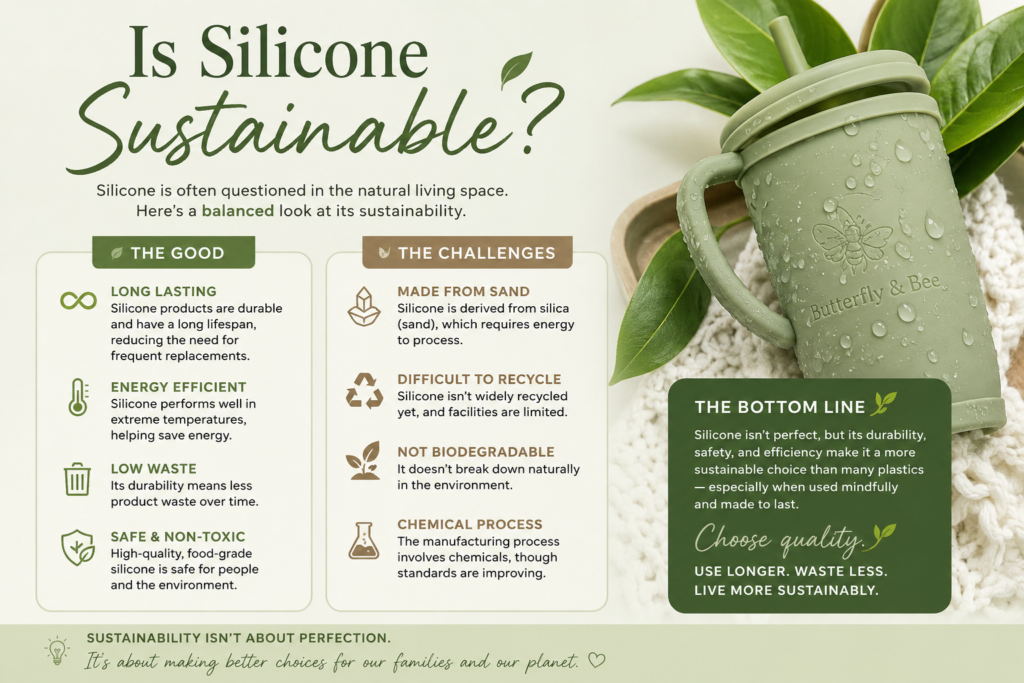
Silicone has become increasingly popular in eco-friendly homes. From reusable food storage bags and baking mats to baby products and kitchen utensils, silicone is often marketed as a more sustainable alternative to plastic. But is silicone sustainable?
The answer is: it depends on how you define sustainability.
What Is Silicone?
Silicone is a synthetic material made primarily from silica, a naturally occurring component found in sand, combined with oxygen, carbon, and hydrogen. Unlike conventional plastics, which are derived entirely from petroleum, silicone is highly durable and designed to withstand repeated use.
Is Silicone Better Than Plastic?
In many applications, silicone can be a more sustainable choice than single-use plastic because it:
- Is extremely durable and long-lasting.
- Can tolerate high and low temperatures.
- Does not easily break down into microplastics.
- Can replace disposable products such as plastic bags and plastic wrap.
- Is generally considered food-safe when made from high-quality materials.
However, silicone is not biodegradable and is not widely accepted in curbside recycling programs.
Advantages of Silicone
Durability
One of silicone’s greatest environmental benefits is its longevity. A reusable silicone baking mat or food storage bag may replace hundreds of disposable alternatives over its lifetime.
Temperature Resistance
Silicone performs well in ovens, freezers, dishwashers, and microwaves, reducing the need for disposable products.
Reduced Waste
Is Silicone Sustainable?
Using reusable silicone products can help households reduce their consumption of single-use plastics.
Limitations of Silicone
It Is Not Biodegradable
Unlike natural fibers such as linen, cotton, or hemp, silicone does not naturally decompose in a home compost system.
Recycling Options Are Limited
Although silicone can technically be recycled, few municipal recycling programs accept it. Specialized recycling facilities may be required.
Manufacturing Requires Energy
Producing silicone requires significant energy and industrial processing, so it should be viewed as a durable material rather than a renewable one.
Is Silicone Eco-Friendly?
Silicone occupies a middle ground. It is generally considered more sustainable than disposable plastic products because of its durability and reusability, but it is not as renewable or biodegradable as natural materials such as beeswax wraps, linen, or glass.
A Good Rule of Thumb
Choose silicone when:
- You need a long-lasting, reusable product.
- Glass would be impractical or unsafe.
- The product will replace many disposable alternatives.
Choose natural materials when possible for products that can realistically be made from:
- Glass
- Linen
- Organic cotton
- Beeswax
- Wood
The Bottom Line
Silicone is not a perfect material, but it can be a practical and lower-waste alternative to single-use plastics when used for durable, reusable products. Like many sustainability questions, the most environmentally friendly choice is often the product you can use repeatedly for many years.